

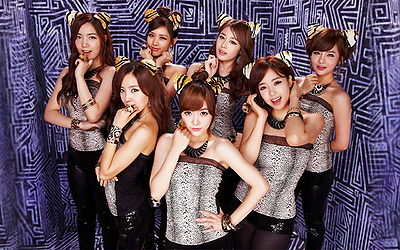
T-ara was formed by the now-defunct MBK Entertainment in 2009, with six members: Eunjung, Hyomin, Jiyeon, Qri, Soyeon, and Boram. Between 2010 and 2015, three other members were part of the group: Areum, Dani, and Hwayoung (the last of which we’ll get to in a minute). As of today, the group isn’t active but has four members: Eunjung, Hyomin, Jiyeon, and Qri.
Here are my credentials: So, like most fans of kpop who discovered it post-3rd gen, I first heard of T-ara through their bullying scandal, which has Hwayoung at the center of it. It’s complicated and I’m not going to go into it here, because this is a music review after all, and I think that the scandal tends to overshadow a decade-and-a-half long career. So I want to discover who T-ara is outside of this, and give their music the kind of analysis I think it deserves. Let’s get into it!
(Also: please excuse the bad image quality; I tried my best).
Album #1: The Absolute First Album / Breaking Heart
I have no idea what the “don’t lose your temper so quickly” distortion at the beginning of Bo Peep Bo Peep is supposed to mean, but sure, I guess. After that, I was a bit on edge, not knowing what to expect. The “follow me, follow me” hook is catchier than I thought it was going to be, but I think I like the idea of it more than the execution. This is the most bubblegum song to ever bubblegum, and yet the music video has so much unnecessary making out in a car and in a club bathroom. Why? Why though? There’s also a lot of distortion and autotune, and it does get a bit…crunchy at times, if you know what I mean. Decisions were made.
It’s unusual nowadays (god I sound old) to debut with a full album, but that’s exactly what T-ara did. From the LP, I enjoyed the breathy vocals and punchy percussion of Like The First Time (처음처럼) and the incredible vocals of Good Person (좋은사람). My hidden gem is probably between two: the delightfully synthy Bye Bye with its constantly building chorus and the jazz-influenced, crying-on-the-dancefloor Lies. This is a dance pop focused release if there ever was one, and I get the feeling that it’s meant to blast on the speakers at a club, not be subjected to close analysis. It’s a hell of a lot of fun, even if a couple of the tracks feel a bit superfluous.
EP #1: Temptastic

Yayaya marks T-ara’s first release with Hwayoung, and my first thought was, “they really like their onamateopiac titles, don’t they”? I think that there’s good parts to the song—the harsher background sound, the rumbling instrumental, the distortion, etc—but they don’t quite seem to work together, especially with the ridiculous over autotuning.
From the EP, while I enjoyed the synthy sound of My Boo and the vocals of I’m Okay, my hidden gem was Why Are You Being Like This? (왜 이러니?), with its rushing beat and catchy hook.
Intermission For Discussion Of Cultural Appropriation (CW)
I may have complained a bit about Bo Peep Bo Peep’s MV but it was pretty harmless; this time, for YaYaYa, we’re doing terrible Indigenous American cultural appropriation that’s just so painful to watch. They mash together important cultural traditions from across the U.S. (wampum belts like the Iroquois, tipis like the Lakota, bad imitations of war cries like the Ojibwe) into one over-simplified, horrible mess. I couldn’t even finish watching. Adding to that, we have all the laziest stereotypes, random feathers in the hair (ignoring the actual significance of placement and color, etc), bad imitations of war dances, and, perhaps worst of all, the idea that all Native American women are just waiting for a civilized man to crash land nearby them so they can kidnap him and become obsessed with him?
No. What is this Andrew Jackson bullshit?
Kpop has a long and painful history of cultural appropriation, I’m not naive to this fact. From very obvious examples like SHINHWA’s use of the n-word in several songs or Mamamoo’s doing blackface on stage to subtler ones like Blackpink wearing black hairstyles in music videos or BigBang imitating the AAVE often found in American hip hop, but it isn’t usually this bad. Also, as I’m sure you noticed, all of these examples are specifically about African Americans, whose music kpop takes a lot of inspiration from.
A lot of it isn’t necessarily meant to be hurtful or demeaning—-which isn’t to say that it’s not, just that it’s not intentional—but a byproduct of many people whose first language isn’t English or who aren’t aware of the hundreds of years of systemic oppression borrowing from genres like R & B, Motown, 80s hits by Michael and Janet Jackson, and especially hip-hop. Again, I’m not saying that any of this is remotely okay, but it is, in a way, somewhat understandable how it happens and why it’s gone on for so long
But with this song, not only was it completely unnecessary, it was obviously very intentional. It’s sickening, and I can’t imagine how someone who’s a member of any tribe—be they Lakota, Ojibwe, Iroquois, Cherokee, Choctaw, Navajo, Blackfeet, or any other of the countless ones I don’t have time to include here—would feel. If any of my readers have membership in a tribe, I am so sorry.
—TW ends—
EP #2: John Travolta Wannabe

Roly-Poly is the first T-ara song on this list that I’ve heard before, which is fitting since it’s one of their biggest hits. It takes a lot of the issues I’ve had before and runs with them, turning the catchphrase chorus, the distortion, and the hints of messiness into a song that really shouldn’t work but really does. If you want a track tailor made for the dancefloor, you can’t really do much better. It was written by the late, great producer Shinsadong Tiger, who died last year at time of writing, and this is probably him at his best.
The MV, in a complete departure from YaYaYa’s, is twelve minutes long and just excellent, telling a story of a group of female friends who go out to a disco party. The whole thing is shown through a flashback, of one of the girls, who’s older and remembering her time as a young woman. It’s just delightful, and, even if you don’t understand any Korean, I’d recommend watching it; you’ll be able to figure out what’s going on. It’s goofy as hell and completely owns it, even managing to make me a little misty-eyed by the end with its earnestness.
Naming an EP “John Travolta Wannabe” gives you a lot to live up to in terms of dance pop, and unfortunately most of this is just remixes. I did really like “I Love You So Much” (진짜 진짜 좋아해); I don’t know why they didn’t just make this a single.
EP #3: Funky Town

Cry Cry opens with this almost angelic, choir sound that I wasn’t expecting, and then shifts to the kind of instrumental that you’d expect to see in a movie set at an old saloon in the Wild West, like 9Muses’ Gun or Infinite’s Last Romeo. It’s fun, just very different from what came before, though it revels in its own drama in the same way as Roll Poly did. The chorus is accompanied by this Spanish guitar that I really enjoyed, with a hint or two of tango in the bridge. Overall, I liked this song a lot, to my surprise.
Lovey-Dovey is the second of T-ara’s songs that I’d known before this deep dive, and besides having a very similar name to Roly Poly, it’s a similar structure too, both in terms of song and in having a long video that tells a story. It’s been one of my favorites since I heard it the first time, with a skippy, propulsive beat that makes you want to dance along and an impressive amount of energy that just doesn’t waver.
Thankfully, this MV is just six minutes, not twelve, though how it manages to include a disco club and a zombie rampage in that time will remain a mystery. It provides for some insane humor when people are being murdered left and right while the girls just keep on dancing, before leading the now zombie-died club in dance. The MV seems determined to give me a seizure for unknown reasons. (Maybe to steal my brain? Who knows?)
From the EP, I enjoyed the wonderfully dramatic strings in Goodbye, Ok? and the funky edge of I’m So Bad. I also liked the ballad version of Cry Cry.
EP #4: Day By Day

Day By Day picks up where Cry Cry left off, and not only with the similar title. It builds on the almost spaghetti western influences and the heavier lean on the crying-on-the-dancefloor sound. There’s an interesting recurring flute sound that I really liked; it reminded me a bit of Dreamcatcher’s PIRI, despite that being a very different song. The chorus is sprawling in a way that really works, and I wasn’t expecting to like it as much as I did, though I wish the verses were more unique.
Sexy Love returns to the solid dance-floor sound, with a bizarre, almost cartoonish beat straight out the gate. It’s almost carnivalesque, fizzy in the way a carbonated drink is right before it explodes. The chorus is just absolutely ridiculous (do tell, how can a nose be sexy?) but in a (mostly) entertaining, over-the-top way. I found myself bopping along in no time. Could’ve done without the clowns, though.
From the EP, I enjoyed the catchy vocalized hook of Holiday and the great vocals in Don’t Leave Me Alone (떠나지마). Something that’s struck me in a lot of their albums is how they’ve kept Hangul titles well into the 2010’s, which isn’t something I’ve seen with many other groups, but I really like it, both in principle and as a linguistics major.
Next time, we’re onto Part 2. Tschüss!

Let me know your thoughts!